Board & Batten Siding in Saskatoon
The vertical profile that runs from prairie farmhouse to modern build, installed in vinyl, engineered wood, fibre cement, or steel.
Board and batten is the profile Saskatchewan invented out of necessity and rediscovered as style, and Saskatoon Siding Co installs it across every material that makes it: vinyl for value, engineered wood for warmth, fibre cement for hail country, and steel for the sharpest modern read.
A Vertical Wall Is Built Sideways First
The whole trick of good board and batten is behind the boards. Vertical cladding cannot fasten to vertical studs, so the wall gets strapped horizontally first, flat, level, and shimmed true, because a vertical profile amplifies every hump a horizontal one would hide. Layout comes next: batten spacing gets planned around windows and corners so the rhythm resolves cleanly at the edges instead of dying in a sliver board beside the garage door.
Then the material goes on with the same envelope discipline as any wall we build, house wrap sound underneath, flashing at every horizontal break, and bottom terminations that drip clear of the foundation.
One Look, Four Materials
Vinyl board and batten delivers the profile at the friendliest price and never needs paint. Engineered wood carries real texture and takes the deep modern-farmhouse colours. Fibre cement panel-and-batten is the hail-belt pick, and vertical steel, covered on our metal siding page, is the most durable and most contemporary of the four. Which one belongs on your house depends on exposure, budget, and how the rest of the exterior is finished, and the written quote prices the comparison rather than assuming it.
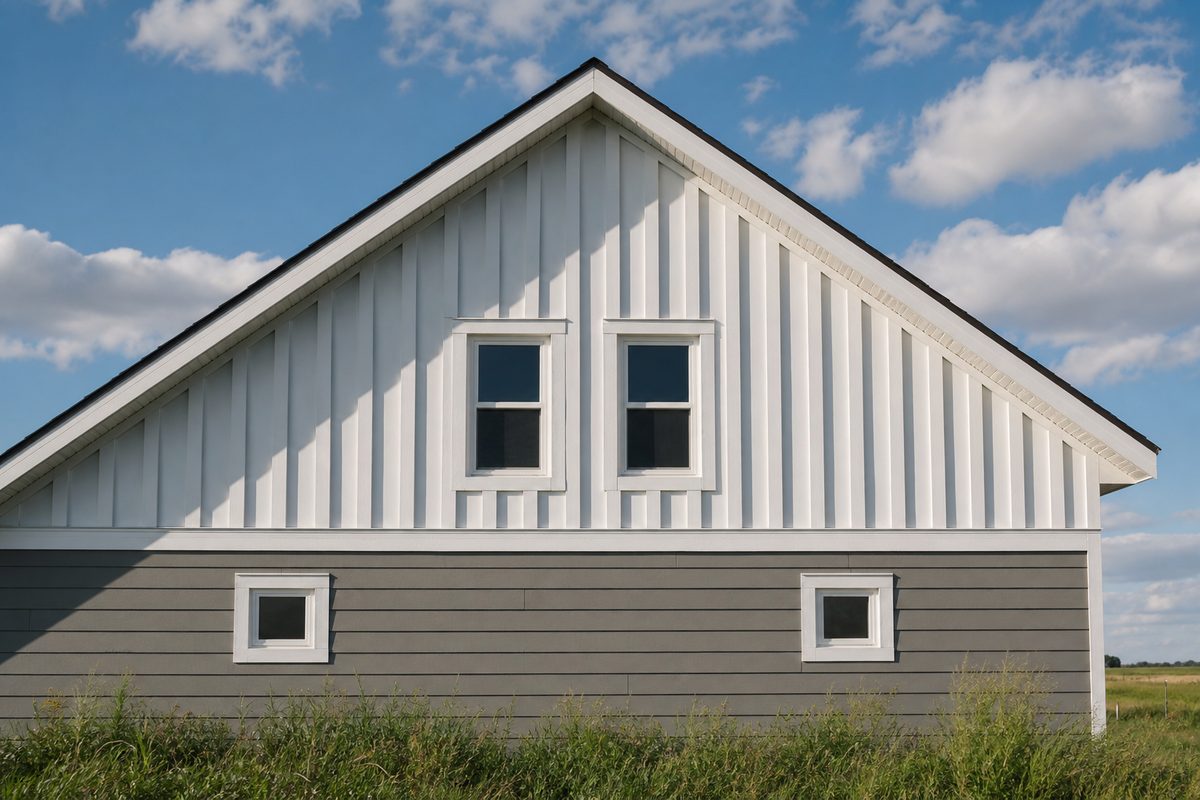
The two-texture exterior dominating new areas like Warman and Martensville pairs a lap main floor with batten gables. If that is the goal, we quote it as one coordinated job with vinyl or Hardie below, batten above, and soffit, fascia, and eavestrough matched across both.
Free written quote, products named, batten layout included in the plan.
What's Included
- Vertical profile in four material families
- Full-height accent gables or whole-wall installs
- Strapping and furring done so verticals hang flat
- Batten spacing laid out to the wall, not left to chance
- Pairs with horizontal lap for two-texture exteriors
Other Services We Offer in Saskatoon
Board & Batten Siding Questions
What exactly is board and batten?
A wall of wide planks stood on end, with a slim batten strip capping each seam. Prairie builders used it because it sealed a granary fast, and architects kept it because the tall shadow lines flatter a building. The pattern is now pressed into vinyl, engineered wood, fibre cement, and steel alike, so choosing the style no longer chooses your material.
Is vertical siding harder to install than horizontal?
It asks for more preparation. Horizontal siding hangs on the wall studs as-built, while vertical cladding needs horizontal strapping or furring behind it so every board lands on solid fastening. Skipping that step is how vertical walls end up wavy. The layout also matters more, since batten lines are strong visual verticals and uneven spacing shows from across the street.
Where does board and batten look best?
Full gables, entry features, and second-storey accents over a horizontal lap main floor are the classic uses, and a whole-wall vertical install suits taller modern builds. In the new subdivisions the two-texture exterior, lap below and batten above, has more or less become the neighbourhood uniform, and done well it earns the popularity.
Does the vertical profile handle weather differently?
Verticals drain fast, which is why the granary wore them first. What modern installs have to get right is the bottom edge, where each board must stop above a flashed drip line, since an end grain parked against a wet ledge will drink all spring. Detailing that termination is where a careful vertical install spends its extra half day.
Get a Free Board & Batten Siding Quote
One site visit, one itemized written scope, zero mystery. That is how a siding quote should read.